
Cuidando los espacios de trabajo

La gestión de la seguridad y la salud forma parte de la gestión de una empresa. Las empresas deben hacer una evaluación de los riesgos para conocer cuáles son los peligros y los riesgos en sus lugares de trabajo, y adoptar medidas para controlarlos con eficacia, asegurando que dichos peligros y riesgos no causen daños a los trabajadores.

La Organización Internacional del Trabajo ha publicado unas directrices sobre el desarrollo de sistemas de gestión de la seguridad y salud en el trabajo.

Estas directrices se concibieron como un instrumento práctico de ayuda a las organizaciones (ya sean empresas, sociedades, establecimientos, compañías, instituciones o asociaciones, o una parte de ellas, públicas o privadas, declaradas o no… que tenga gestión y funciones), y a las instituciones competentes para mejorar de manera continuada la eficacia de la SST. 

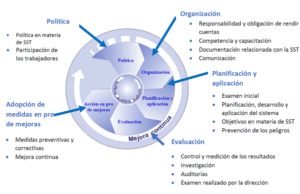
La seguridad y la salud en el trabajo, incluyendo el cumplimiento de los requisitos en materia de Seguridad y Salud en el Trabajo (SST) con arreglo a las legislaciones nacionales, son responsabilidad y deber del empleador. El empleador debería dar muestras de un liderazgo y compromiso firmes respecto de las actividades de SST en la organización, y adoptar las disposiciones necesarias para el establecimiento de un sistema de gestión de la SST que incluya los principales elementos de política, organización, planificación y aplicación, evaluación y acción en pro de mejoras, tal como se muestra en el gráfico.
La percepción en el incremento de los riesgos asociados al impacto del Covid-19 puede verse cuando se evalúa cuán desafiante era el trabajo antes y durante la pandemia:

Previo a marzo de 2020, el 72,80% valoraba a los riesgos como positivamente desafiantes, pero a partir del año pasado esa valoración disminuyó considerablemente para ubicarse en un 58,24%. 

Como contrapartida, la percepción negativa aumentó del 14,45% al 32,18%, duplicándose.

Al consultarse sobre las áreas de la seguridad en las que planean enfocarse las empresas en el corto plazo, las preferencias fueron las siguientes:

  • Involucrar a los empleados en la seguridad (+70%)
  • Realizar evaluaciones de riesgo (+60%)
  • Gestionar sustancias peligrosas (+30%)
  • Asegurar el compliance legal de la empresa (+30%)
  • Ejecutar programas de auditorías (+30%)
  • Implementar un software de EHS o una APP (+20%)
  • Implementar prácticas de Safety II/ Safety Differently (+10%)

Cuidar de los colaboradores es una responsabilidad de todas las empresas.

En GDI Uniformes, nos preocupamos por nuestros colaboradores, buscamos la mejor forma en la que nuestro equipo se sienta seguro dentro de las instalaciones.

Cuidamos  de nuestra familia y de su bienestar.

 

They look after your health and take care of their image.

The uniforms in this sector are very important for health care personnel, based on dress codes depending on the hospital, clinic or practice. Their main function is to protect the specialist and the patient from the spread of infection.

Not only do they fulfil their protective function, but they are also part of the image of people working in health care, demonstrating hygiene, trust, respect and dedication, which makes a good impression on the patient.

Depending on the type of work to be carried out, different accessories are required for comfort, and it is essential that they facilitate hygiene during the working day. 

BENEFITS OF WEARING UNIFORMS

The health sector uniforms provide different benefits when worn correctly, ranging from presentation to a patient to protection against bacteria. These include:

  1. It facilitates the identification and classification of personnel.
  2. Protection against body fluids and chemicals.
  3. They prevent cross-contamination between different infections in a hospital.
  4. They provide greater mobility and comfort for health workers.
  5. They make the patient feel comfortable.
  6. They are suitable for all body shapes.
  7. They promote hygiene.
  8. They are functional, with pockets where different work tools can be carried.

In addition to these benefits the medical uniforms have designs and colours that match those of the institution.

  • This provides employees with identity and a sense of belonging.
  • They demonstrate to patients and relatives the integrity and organisation of the institution.
  • They express the dedication and professionalism of the medical centre's employees.

CHARACTERISTICS OF A GOOD UNIFORM 

  1. It should be made of materials that reduce the spread of airborne infections.
  2. To enable efficient hand hygiene.
  3. Comfortable for the movement of the user.
  4. It must be a hypoallergenic fabric.
  5. Easy to wash, sun and chemical resistant.

HOW TO CHOOSE

Depending on the type of work you do, you will require different accessories for comfort, and it is also essential that they facilitate hygiene during your working day. 

  • Sanitary pyjamas: the most important thing when choosing this set of coat and trousers is that the fabric is the least prone to the propagation of microorganisms, that it does not produce static (to avoid possible explosions), is resistant to chemical substances and is blue or green in colour to contribute to the visual aesthetics of the sector. Currently, one of the most widely used fabrics is drill fabric (composed of vegetable fibre, cotton and spandex), whose resistance to washing and exposure in the workplace is the most recommended.  

Each one is suitable for a different use, for this reason there are designs with long or short sleeves, with front zip or buttons.

  • Sanitary gowns: they prevent staining of the sanitary pyjamas and identify doctors and surgeons. You can find single-use gowns, or the common long-sleeved white gowns.
  • Sanitary caps: these are an essential part of the sanitary wardrobe. They are usually disposable, as are masks, to guarantee safety and hygiene.
  • Healthcare footwear: anatomical footwear with non-slip soles contributes to the comfort of healthcare workers during the working day. Health clogs are the most commonly used by doctors and nurses as they fit snugly to the foot and are made of breathable material.

At GDI you will find a wide range of garments. We are experts in various sectors and our track record confirms it.

We provide a comprehensive service, which encompasses all the features that uniforms require. This comprehensive service ranges from safety, comfort and a design that differentiates your staff. We are your best option when choosing the clothing for your employees,

Contact us for our garment catalogues for your sector.